
2026
David Bailin
The following are the notes from my artist talk at ArtYard at the opening weekend of A Divine Comedy. As in all my talks, I extemporized during the presentation and for that reason, I recommend listening to it rather than reading it. Be that as it may, I present the notes below.
The filming was done in 15 minute increments by my daughter, Patsy, my wife, Amy Stewart, and my sister-in-law, Beth Stewart Salovaara.
The filming was done in 15 minute increments by my daughter, Patsy, my wife, Amy Stewart, and my sister-in-law, Beth Stewart Salovaara.
When we walk through museums, visit exhibitions and look at art, we come with preconceptions, prejudices and preferences, and, if you are an artist, take from those works ideas and processes we could use as our own. Much of the time we come away with our opinions affirmed, pushed to reconsider an artist’s work, or just excited to get back into the studio.
But sometimes, a work of art produces a sudden insight or, in my case, a discovery that reshapes my approach to art making.
click for slide image
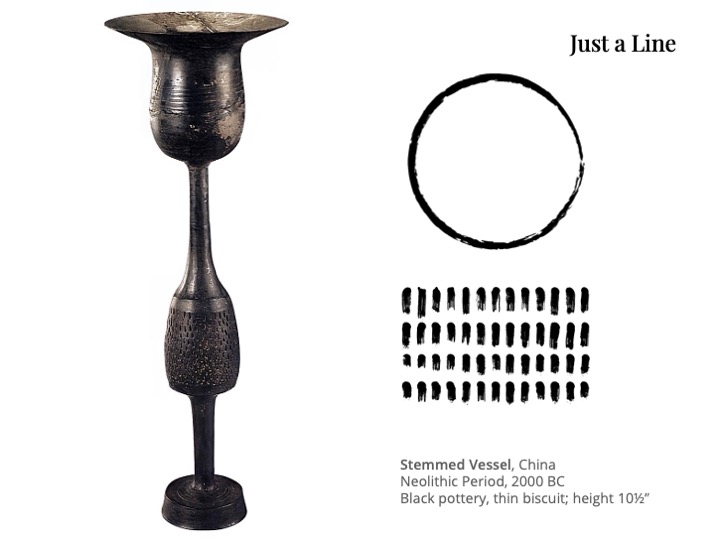
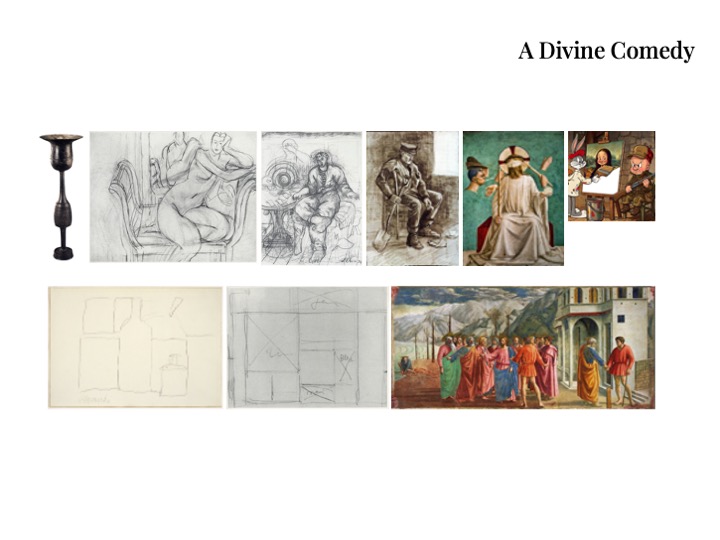
The piece is exceptionally unbalanced for a vessel holding liquid and too fragile for everyday use. Texts infer that this was a ceremonial object. The design around the cup is a series of stacked incised lines, the stem’s node is comprised of stippled marks and the base concentric circles.
I must have presented this object in my art appreciation class hundreds of times but it struck me that while the decoration is simple, repeating linear patterns, there was greater meaning here that made it a ceremonial object beyond its physical appearance: the vessel as a whole suggested a plant and the concentric circles on the base suggested water, the collar a root, the node a seed pod, the cup with its stacked circles air or sky.. Here simple lines created a representation of the world - water, earth, sky. Simple lines.
A mark does not have meaning in isolation, but it does contain significance. Thin vs thick, dark vs light, defines object vs space, depicts light or shadows, patterns or textures, foreground or background. Sometimes the line itself creates a narrative.
How a drawing is made, constructed, is as important as the images depicted.
click for slide image
The artist drawings, revises and refines their image. In drawing, the viewer can see the search and the method for developing an idea.
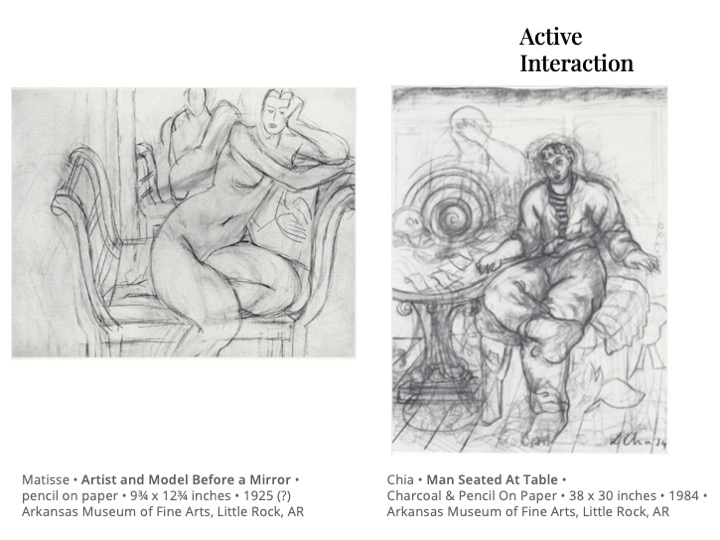
In Matisse's drawing, the model and divan is moved up and to the right, drawn larger and adjusted horizontally. The model’s legs moved and revised.
In Chia's Man Seated at Table, it appears as if he created the drawing improvisational sometimes adding, subtracting or replacing elements. Ghosts of other figures, chairs, skulls, dogs and pedestals haunt the drawing. The final image still seems to be influx.
Line quality-lightness or darkness, thickness or thinness, slowness or fastness- produces object clarity and spatial nuances.
This is a process that informs all my drawings. The active drawing in and erasing out, the remnants of under drawing creating tonality as well as textural and thematic nuance, the blow back of errors and failures, lost direction and final resolution. Without this interaction, the drawing becomes a document, a diagram not a work of art.
click for slide image
Continuing on this line, changing a drawing implement can change the meaning of a whole drawing.
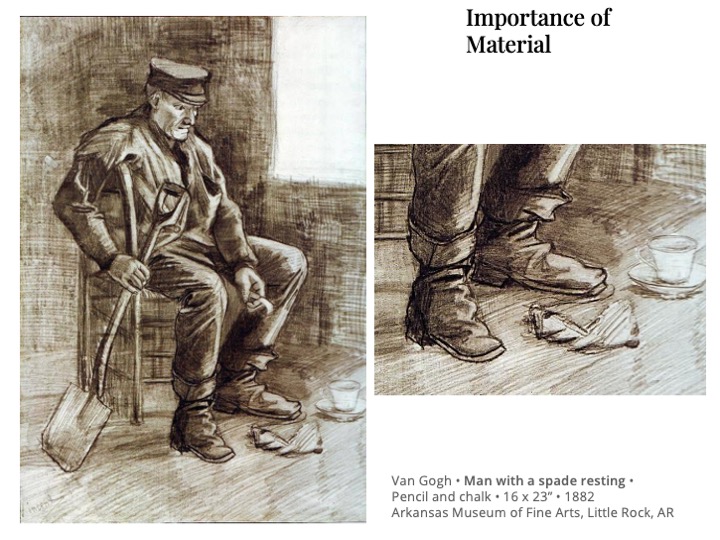
In 1880, Van Gogh was religious and politically engaged. Rather than resort to propaganda, Van Gogh, in Man with a spade resting, uses two types of line to subtly make his feelings known about the injustice disparity between two classes.
The blunt, thickly drawn B pencil that chisels out the Man, spade and tool and tears the paper is contrasted with a sharpened, delicately drawn contour line in an H pencil that draws a cup and saucer set on the floor to the man's right.
One can’t help wondering why Van Gogh put the porcelain cup in this scene since the handle is too small to fit his finger and would break if kept in this environment. And that is the point. By simply changing to a different pencil Van Gogh has created a political and social statement.
The artist must consider both the use of the materials and the approach to depicting the objects the artist has chosen.
click for slide image
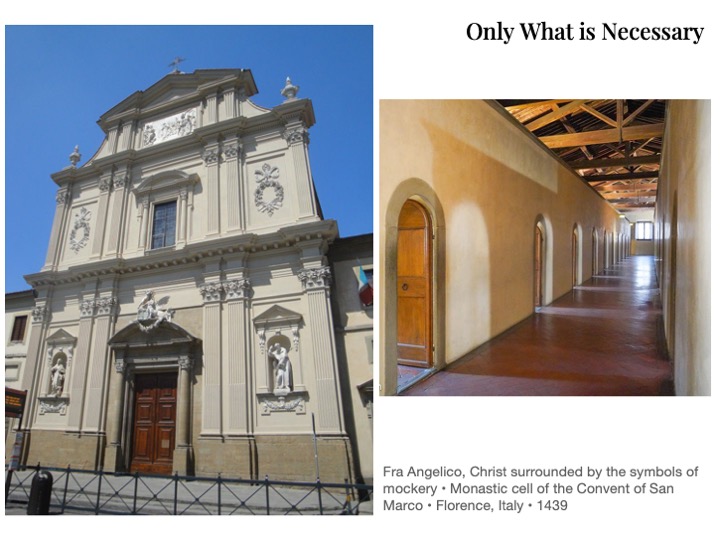
I got a chance to study in Florence and during that time I visited the Convent of San Marco where Fra Angelico had painted frescos.
Those frescos were painted in the monastic cells on the second floor of the dormitory. On either side of the hallway, large bright windows cast almost blinding light through the floor.
When you entered a monk’s cell, your eyes had to adjust for there was only a small window against the far wall. Next to that window, you could barely make out an image.
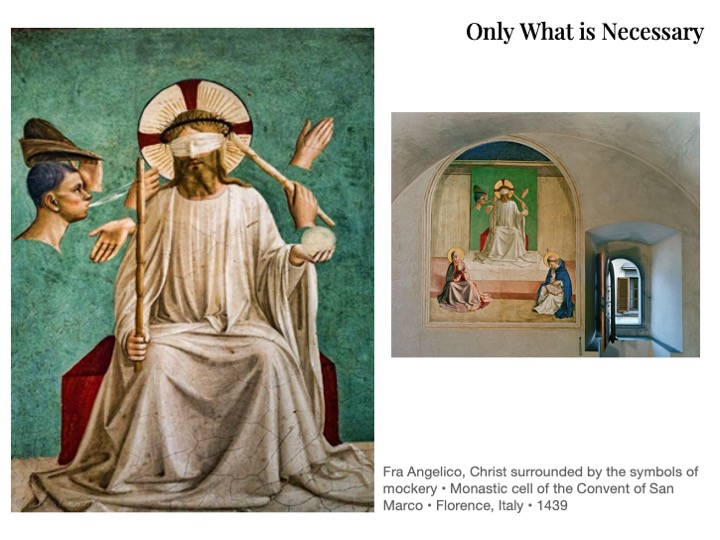
A crown of thorns, a man spitting, a stick, a couple of hands waving. As your eyes adjusted you realized…
click for slide image
There was no body to the face spitting, in fact no bodies at all, none holding the stick or supporting the hands. The only body Fra Angelico needed was that of Christ.
I didn’t need those bodies to project my vision of the story. Fra Angelico deliberately left out those details because they were not important to the story – a story that focuses on Christ’s torment. Fra Angelico had opened the space for the monks to imagine the torture, the scene.
A work of art does not need to include everything. The artist needs to trust their viewers. Provide the space for interpretation.
Only draw what is necessary.
click for slide image
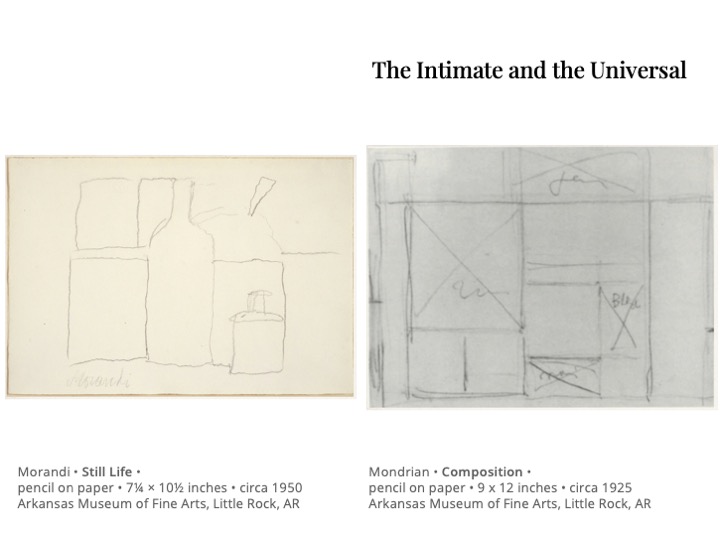
Morandi was a private artist working in a storage room off his mother's kitchen. His subjects were solely the bottles and vessels he meticulously arranged for his painting. His drawing reflects the care he took to compose the forms-each blocked into an area tightly packed, grid-like. Each less a bottle than a geometric abstracted form.
Like Morandi, Mondrian limited his subject matter. For Mondrian, the vertical and horizontal lines he likened to the way we stand in our environment and landscape that spreads out horizontally. He uses the same geometric abstract forms to populate his drawing.
What strikes me is that I would be hard pressed to say which of the two makes a universal statement and which makes an intimate one just looking at the preparatory drawings. And that is the point.
click for slide image
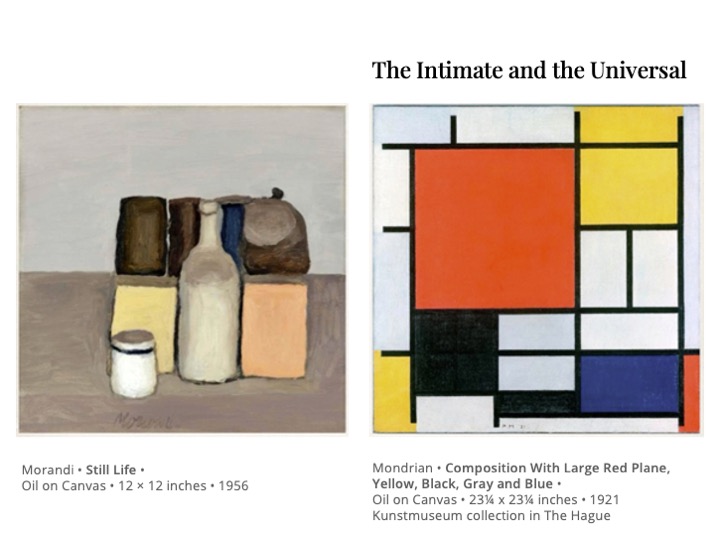
While the paintings are dissimilar obviously in color and technique, both paintings use a grid to position their objects. In each, the color planes lie at the very surface of the canvas -there isn’t space created in the classical way.
Looking at the paintings the distinction between the intimate and the universal becomes apparent.
Morandi’s poor bottles are literally clamped into the center of the painting by the background and foreground shapes. They are isolated - only the small white jar looks like it could break away. In many ways that painting reflects his private life.
Limiting his colors to the primaries and black and white, and using only perpendicular black vertical and horizontal lines Mondrian employed a style based on a reduction of painting itself- a painting is a flat surface, the edges determine the interior structure, the colors are only flat red, yellow and blue, composition is the combination balance of these elements. With this rubric he believed is painting spoke of a universal and harmonious truth.
By seeing how both artists start their journey led me to understand that the artist who is truly drawing upon the personal can create a statement that can speak towards a universal one just as the artist who succeeds in making a universal statement can also make a very personal one.
Within the personal then lies the universal, within the universal lies the personal. Losing track of that duality, the artist risks making work either wallpaper or navel gazing.
click for slide image
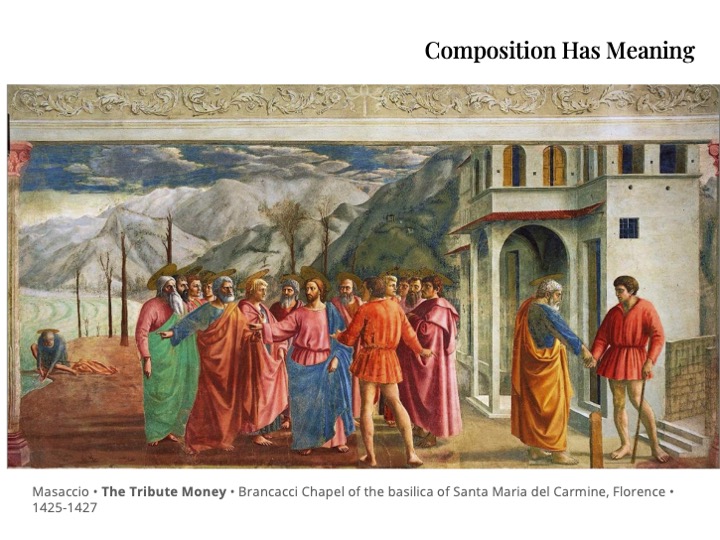
That duality is apparent in Masaccio the tribute money.
How does an artist tell a story with only a single view available - to refine the story into one important action. - the surface of a canvas that does not change in time.. Medieval artists would tell a story using space cells to create panels depicting each important development like a comic book. But there is a difference between reading a story and viewing one.
Masaccio has all the important parts of the story The Tribute Money in a continuous narrative, but he does not place them the sequentially. And does not place them in space cells. While the perspective lines of the architecture leads our eye to Christ that focus is enhanced by the Tax collector who literally steps into the painting towards Christ. Jesus serves then as a fulcrum around which the time frame changes but the setting doesn’t. We don’t notice it because our eye moves naturally to the predominate middle section with the tax collector confronting Jesus and the crowd circled around him. Jesus gestures to left and our eyes moves to Peter opening the mouth of a fish and finding a coin. Our eye then swings back towards the group of apostles and continues moving across the bluish mountains to the other side where Peter, in his blue tunic pays the Tax collector.
A perfect composition playing out a new testament story - one that the monks and congregates knew well.
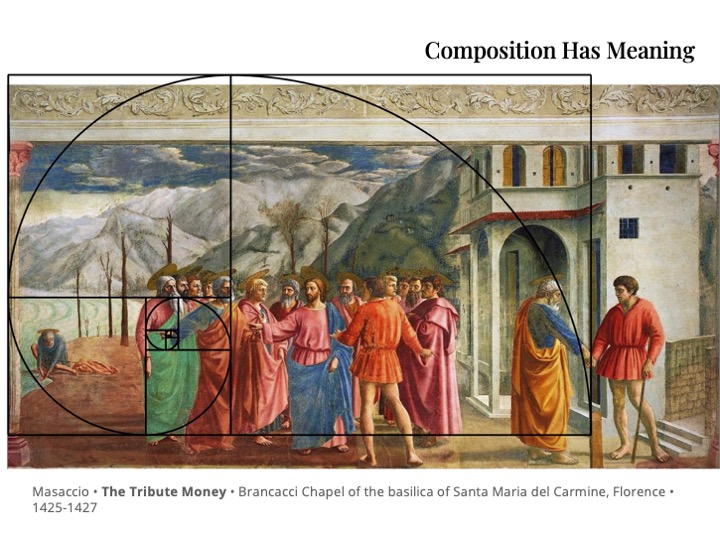
But Masaccio has inserted another storyline created purely by a subtle compositional format one the speaks more to Masaccio’s personal interests in the mathematical breakthroughs and study of his age (in perspective, proportion aligned with mathematical concepts).
Let’s look at what happens when this particular mathematical sequence is overlaid on the fresco:
click for slide image
While Masaccio depicts the fresco as the monks would know it from Mark 17-22 that focuses upon Jesus’s clever escape from the heresy trap by saying “render under Caesar that which is Caesar’s, Masaccio hides another more personal one by employing another compositional device. In this overlay which is a mathematical sequence known to M as the Fibonacci Sequence - used to create the golden rectangle and found in natural forms) we realize that Masaccio focuses on Peter’s actions and so shifts it from focusing on Jesus! It is so subtle that we don’t at first see it if we would see it at all.
In other words, when Masaccio depicted the story of the tribute money he added another very subtle but personal one that focused on Peter completing a task that occurred required following a man-made law not a spiritual one. Here, Masaccio reminds the monks that they are also in a man-made contract with him. He is saying I might be painting a religious work of art, but I also live in a world of commerce and payment I must receive.
For me I realized that composition can be used by the artist not just as an armature for constructing a scene but as a narrative device as powerful as the characters and setting the artist chooses to depict.
All of the previous speak to the divine in the creative act. But there is one more insight to be received, one coming not from a museum or exhibition but from television.
click for slide image
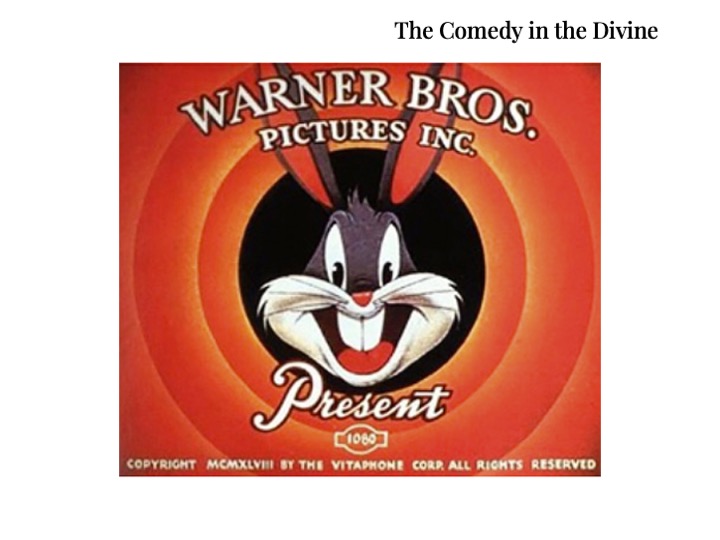
As a child I saw a Bugs Bunny cartoon in which Bugs, dressed in an artist smock and beret, and dipping a large brush into a bucket of paint, paints the Mona Lisa in two passes of his hand. This was an amazing thing to watch. I could never figure out how he did that. Every time I lifted a brush or drew a line it appeared to be so limited. But later I realized what that joke really meant for the artist: create the greatest amount of significance with the least amount of effort. You see it in masterful work. It only seems like the piece just appeared fully formed and effortless.
click for slide image
The way you use line affects the meaning of a drawing, the process is as much about exhausting the possibilities through active participation with the materials, how you use materials creates meaning, include that which is necessary - trust the viewer, view the work as a participant and a viewer, composition is not just an armature a storyline itself, and most importantly, create the most significance with the least amount of effort.
The result is a framework for evaluating the success or failure of my drawings. I may start my work staring at a blank sheet of paper, but it ends in a party where all the artists I have discovered take part in the final result. A divine comedy of ‘aha moments’ and ridiculous pratfalls.
But sometimes, a work of art produces a sudden insight or, in my case, a discovery that reshapes my approach to art making.
click for slide image
The piece is exceptionally unbalanced for a vessel holding liquid and too fragile for everyday use. Texts infer that this was a ceremonial object. The design around the cup is a series of stacked incised lines, the stem’s node is comprised of stippled marks and the base concentric circles.
I must have presented this object in my art appreciation class hundreds of times but it struck me that while the decoration is simple, repeating linear patterns, there was greater meaning here that made it a ceremonial object beyond its physical appearance: the vessel as a whole suggested a plant and the concentric circles on the base suggested water, the collar a root, the node a seed pod, the cup with its stacked circles air or sky.. Here simple lines created a representation of the world - water, earth, sky. Simple lines.
A mark does not have meaning in isolation, but it does contain significance. Thin vs thick, dark vs light, defines object vs space, depicts light or shadows, patterns or textures, foreground or background. Sometimes the line itself creates a narrative.
How a drawing is made, constructed, is as important as the images depicted.
click for slide image
The artist drawings, revises and refines their image. In drawing, the viewer can see the search and the method for developing an idea.
In Matisse's drawing, the model and divan is moved up and to the right, drawn larger and adjusted horizontally. The model’s legs moved and revised.
In Chia's Man Seated at Table, it appears as if he created the drawing improvisational sometimes adding, subtracting or replacing elements. Ghosts of other figures, chairs, skulls, dogs and pedestals haunt the drawing. The final image still seems to be influx.
Line quality-lightness or darkness, thickness or thinness, slowness or fastness- produces object clarity and spatial nuances.
This is a process that informs all my drawings. The active drawing in and erasing out, the remnants of under drawing creating tonality as well as textural and thematic nuance, the blow back of errors and failures, lost direction and final resolution. Without this interaction, the drawing becomes a document, a diagram not a work of art.
click for slide image
Continuing on this line, changing a drawing implement can change the meaning of a whole drawing.
In 1880, Van Gogh was religious and politically engaged. Rather than resort to propaganda, Van Gogh, in Man with a spade resting, uses two types of line to subtly make his feelings known about the injustice disparity between two classes.
The blunt, thickly drawn B pencil that chisels out the Man, spade and tool and tears the paper is contrasted with a sharpened, delicately drawn contour line in an H pencil that draws a cup and saucer set on the floor to the man's right.
One can’t help wondering why Van Gogh put the porcelain cup in this scene since the handle is too small to fit his finger and would break if kept in this environment. And that is the point. By simply changing to a different pencil Van Gogh has created a political and social statement.
The artist must consider both the use of the materials and the approach to depicting the objects the artist has chosen.
click for slide image
I got a chance to study in Florence and during that time I visited the Convent of San Marco where Fra Angelico had painted frescos.
Those frescos were painted in the monastic cells on the second floor of the dormitory. On either side of the hallway, large bright windows cast almost blinding light through the floor.
When you entered a monk’s cell, your eyes had to adjust for there was only a small window against the far wall. Next to that window, you could barely make out an image.
A crown of thorns, a man spitting, a stick, a couple of hands waving. As your eyes adjusted you realized…
click for slide image
There was no body to the face spitting, in fact no bodies at all, none holding the stick or supporting the hands. The only body Fra Angelico needed was that of Christ.
I didn’t need those bodies to project my vision of the story. Fra Angelico deliberately left out those details because they were not important to the story – a story that focuses on Christ’s torment. Fra Angelico had opened the space for the monks to imagine the torture, the scene.
A work of art does not need to include everything. The artist needs to trust their viewers. Provide the space for interpretation.
Only draw what is necessary.
click for slide image
Morandi was a private artist working in a storage room off his mother's kitchen. His subjects were solely the bottles and vessels he meticulously arranged for his painting. His drawing reflects the care he took to compose the forms-each blocked into an area tightly packed, grid-like. Each less a bottle than a geometric abstracted form.
Like Morandi, Mondrian limited his subject matter. For Mondrian, the vertical and horizontal lines he likened to the way we stand in our environment and landscape that spreads out horizontally. He uses the same geometric abstract forms to populate his drawing.
What strikes me is that I would be hard pressed to say which of the two makes a universal statement and which makes an intimate one just looking at the preparatory drawings. And that is the point.
click for slide image
While the paintings are dissimilar obviously in color and technique, both paintings use a grid to position their objects. In each, the color planes lie at the very surface of the canvas -there isn’t space created in the classical way.
Looking at the paintings the distinction between the intimate and the universal becomes apparent.
Morandi’s poor bottles are literally clamped into the center of the painting by the background and foreground shapes. They are isolated - only the small white jar looks like it could break away. In many ways that painting reflects his private life.
Limiting his colors to the primaries and black and white, and using only perpendicular black vertical and horizontal lines Mondrian employed a style based on a reduction of painting itself- a painting is a flat surface, the edges determine the interior structure, the colors are only flat red, yellow and blue, composition is the combination balance of these elements. With this rubric he believed is painting spoke of a universal and harmonious truth.
By seeing how both artists start their journey led me to understand that the artist who is truly drawing upon the personal can create a statement that can speak towards a universal one just as the artist who succeeds in making a universal statement can also make a very personal one.
Within the personal then lies the universal, within the universal lies the personal. Losing track of that duality, the artist risks making work either wallpaper or navel gazing.
click for slide image
That duality is apparent in Masaccio the tribute money.
How does an artist tell a story with only a single view available - to refine the story into one important action. - the surface of a canvas that does not change in time.. Medieval artists would tell a story using space cells to create panels depicting each important development like a comic book. But there is a difference between reading a story and viewing one.
Masaccio has all the important parts of the story The Tribute Money in a continuous narrative, but he does not place them the sequentially. And does not place them in space cells. While the perspective lines of the architecture leads our eye to Christ that focus is enhanced by the Tax collector who literally steps into the painting towards Christ. Jesus serves then as a fulcrum around which the time frame changes but the setting doesn’t. We don’t notice it because our eye moves naturally to the predominate middle section with the tax collector confronting Jesus and the crowd circled around him. Jesus gestures to left and our eyes moves to Peter opening the mouth of a fish and finding a coin. Our eye then swings back towards the group of apostles and continues moving across the bluish mountains to the other side where Peter, in his blue tunic pays the Tax collector.
A perfect composition playing out a new testament story - one that the monks and congregates knew well.
But Masaccio has inserted another storyline created purely by a subtle compositional format one the speaks more to Masaccio’s personal interests in the mathematical breakthroughs and study of his age (in perspective, proportion aligned with mathematical concepts).
Let’s look at what happens when this particular mathematical sequence is overlaid on the fresco:
click for slide image
While Masaccio depicts the fresco as the monks would know it from Mark 17-22 that focuses upon Jesus’s clever escape from the heresy trap by saying “render under Caesar that which is Caesar’s, Masaccio hides another more personal one by employing another compositional device. In this overlay which is a mathematical sequence known to M as the Fibonacci Sequence - used to create the golden rectangle and found in natural forms) we realize that Masaccio focuses on Peter’s actions and so shifts it from focusing on Jesus! It is so subtle that we don’t at first see it if we would see it at all.
In other words, when Masaccio depicted the story of the tribute money he added another very subtle but personal one that focused on Peter completing a task that occurred required following a man-made law not a spiritual one. Here, Masaccio reminds the monks that they are also in a man-made contract with him. He is saying I might be painting a religious work of art, but I also live in a world of commerce and payment I must receive.
For me I realized that composition can be used by the artist not just as an armature for constructing a scene but as a narrative device as powerful as the characters and setting the artist chooses to depict.
All of the previous speak to the divine in the creative act. But there is one more insight to be received, one coming not from a museum or exhibition but from television.
click for slide image
As a child I saw a Bugs Bunny cartoon in which Bugs, dressed in an artist smock and beret, and dipping a large brush into a bucket of paint, paints the Mona Lisa in two passes of his hand. This was an amazing thing to watch. I could never figure out how he did that. Every time I lifted a brush or drew a line it appeared to be so limited. But later I realized what that joke really meant for the artist: create the greatest amount of significance with the least amount of effort. You see it in masterful work. It only seems like the piece just appeared fully formed and effortless.
click for slide image
The way you use line affects the meaning of a drawing, the process is as much about exhausting the possibilities through active participation with the materials, how you use materials creates meaning, include that which is necessary - trust the viewer, view the work as a participant and a viewer, composition is not just an armature a storyline itself, and most importantly, create the most significance with the least amount of effort.
The result is a framework for evaluating the success or failure of my drawings. I may start my work staring at a blank sheet of paper, but it ends in a party where all the artists I have discovered take part in the final result. A divine comedy of ‘aha moments’ and ridiculous pratfalls.