


Composition Has Meaning: Part Six of Eight
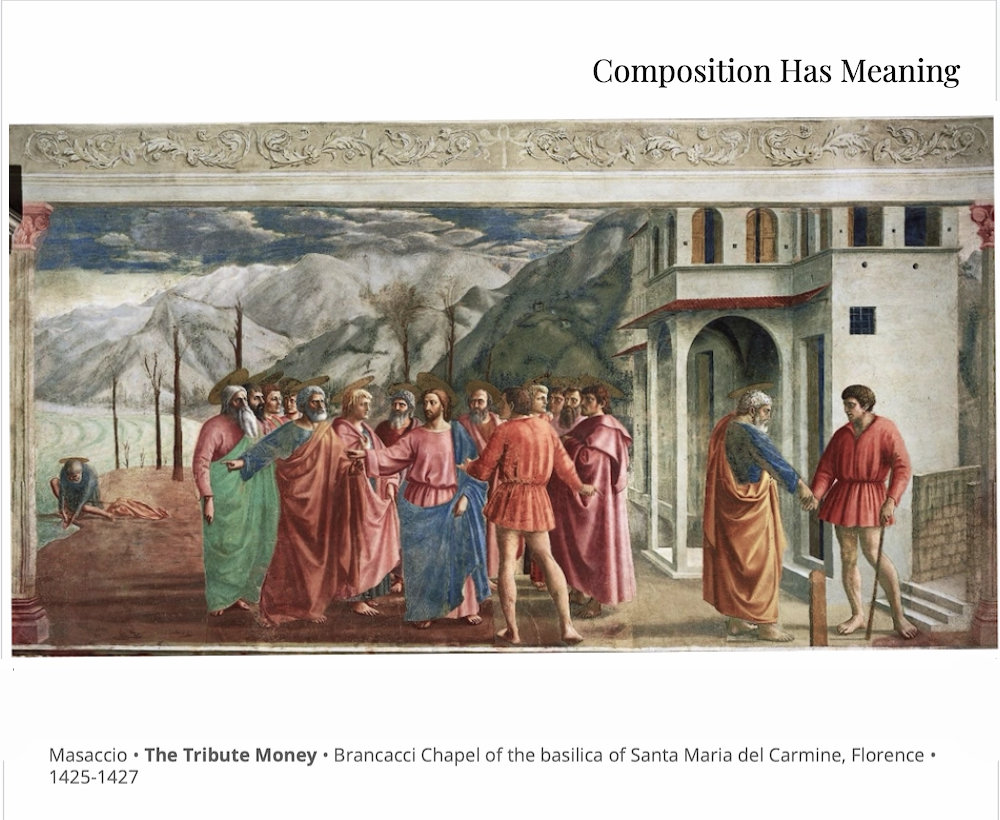
That duality is apparent in Masaccio's The Tribute Money.
How does an artist tell a story with only a single view available - to refine the story into one important action. - the surface of a canvas that does not change in time.. Medieval artists would tell a story using space cells to create panels depicting each important development like a comic book. But there is a difference between reading a story and viewing one.
Masaccio has all the important parts of the story The Tribute Money in a continuous narrative, but he does not place them the sequentially. And does not place them in space cells. While the perspective lines of the architecture leads our eye to Christ that focus is enhanced by the Tax collector who literally steps into the painting towards Christ. Jesus serves then as a fulcrum around which the time frame changes but the setting doesn't. We don't notice it because our eye moves naturally to the predominate middle section with the tax collector confronting Jesus and the crowd circled around him. Jesus gestures to left and our eyes moves to Peter opening the mouth of a fish and finding a coin. Our eye then swings back towards the group of apostles and continues moving across the bluish mountains to the other side where Peter, in his blue tunic, pays the Tax collector.
A perfect composition playing out a new testament story - one that the monks and congregates knew well.
But Masaccio has inserted another storyline created purely by a subtle compositional format one the speaks more to Masaccio's personal interests in the mathematical breakthroughs and study of his age (in perspective, proportion aligned with mathematical concepts).
Let's look at what happens when this particular mathematical sequence is overlaid on the fresco:
How does an artist tell a story with only a single view available - to refine the story into one important action. - the surface of a canvas that does not change in time.. Medieval artists would tell a story using space cells to create panels depicting each important development like a comic book. But there is a difference between reading a story and viewing one.
Masaccio has all the important parts of the story The Tribute Money in a continuous narrative, but he does not place them the sequentially. And does not place them in space cells. While the perspective lines of the architecture leads our eye to Christ that focus is enhanced by the Tax collector who literally steps into the painting towards Christ. Jesus serves then as a fulcrum around which the time frame changes but the setting doesn't. We don't notice it because our eye moves naturally to the predominate middle section with the tax collector confronting Jesus and the crowd circled around him. Jesus gestures to left and our eyes moves to Peter opening the mouth of a fish and finding a coin. Our eye then swings back towards the group of apostles and continues moving across the bluish mountains to the other side where Peter, in his blue tunic, pays the Tax collector.
A perfect composition playing out a new testament story - one that the monks and congregates knew well.
But Masaccio has inserted another storyline created purely by a subtle compositional format one the speaks more to Masaccio's personal interests in the mathematical breakthroughs and study of his age (in perspective, proportion aligned with mathematical concepts).
Let's look at what happens when this particular mathematical sequence is overlaid on the fresco:
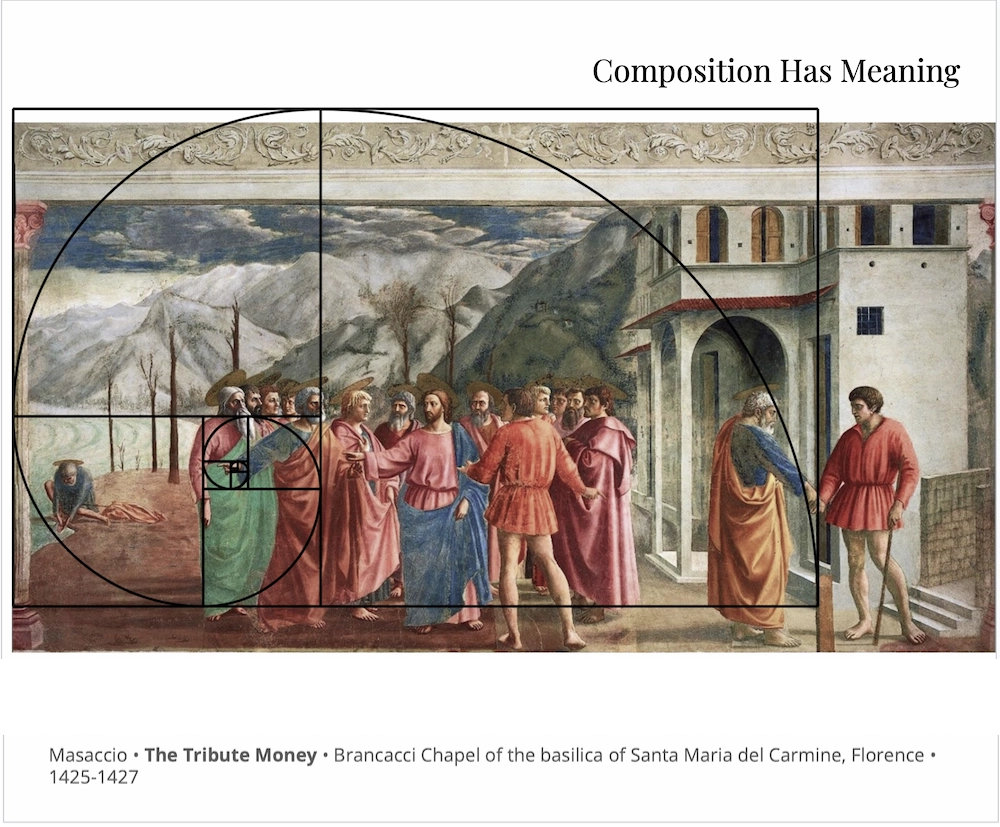
While Masaccio depicts the fresco as the monks would know it from Mark 17-22 that focuses upon Jesus's clever escape from the heresy trap by saying "render under Caesar that which is Caesar's, Masaccio hides another more personal one b employing another compositional device. In this overlay which is a mathematical sequence known to Masaccio as the Fibonacci Sequence - used to create the golden rectangle and found in natural forms) we realize that Masaccio focuses on Peter's actions and so shifts it from focusing on Jesus! It is so subtle that
we don't at first see it if we would see it at all.
In other words, when Masaccio depicted the story of the tribute money he added another very subtle but personal one that focused on Peter completing a task that occurred required following a man-made law not a spiritual one. Here, Masaccio reminds the monks that they are also in a man-made contract with him. He is saying I might be painting a religious work of art, but I also live in a world of commerce and payment I must receive.
For me I realized that composition can be used by the artist not just as an armature for constructing a scene but as a narrative device as powerful as the characters and setting the artist chooses to depict.
All of the previous speak to the divine in the creative act. But there is one more insight to be received, one coming not from a museum or exhibition but from television.
we don't at first see it if we would see it at all.
In other words, when Masaccio depicted the story of the tribute money he added another very subtle but personal one that focused on Peter completing a task that occurred required following a man-made law not a spiritual one. Here, Masaccio reminds the monks that they are also in a man-made contract with him. He is saying I might be painting a religious work of art, but I also live in a world of commerce and payment I must receive.
For me I realized that composition can be used by the artist not just as an armature for constructing a scene but as a narrative device as powerful as the characters and setting the artist chooses to depict.
All of the previous speak to the divine in the creative act. But there is one more insight to be received, one coming not from a museum or exhibition but from television.