


Active Interaction: Part Two of Nine
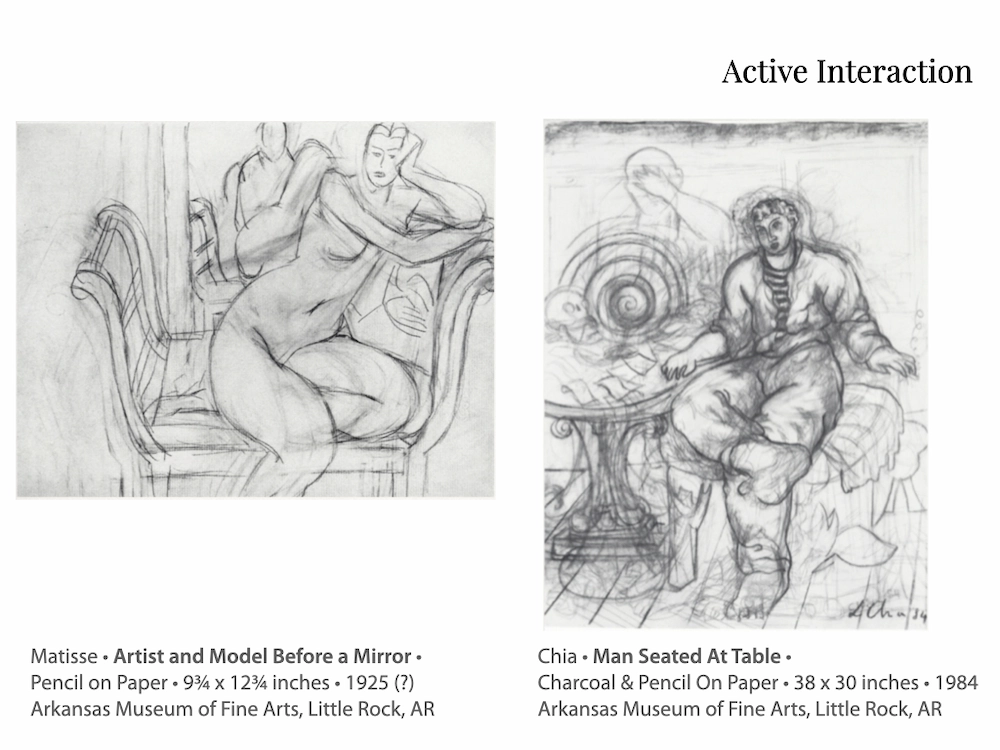
The artist drawings, revises and refines their image. In drawing, the viewer can see the search and the method for developing an idea.
In Matisse's drawing, the model and divan is moved up and to the right, drawn larger and adjusted horizontally. The model's legs moved and revised.
In Chia's Man Seated at Table, it appears as if he created the drawing improvisational sometimes adding, subtracting or replacing elements. Ghosts of other figures, chairs, skulls, dogs and pedestals haunt the drawing. The final image still seems to be influx.
Line quality-lightness or darkness, thickness or thinness, slowness or fastness-produces object clarity and spatial nuances. This is a process that informs all my drawings. The active drawing in and erasing out, the remnants of under drawing creating tonality as well as textural and thematic nuance, the blow back of errors and failures, lost direction and final resolution. Without this interaction, the drawing becomes a document, a diagram not a work of art.
In Matisse's drawing, the model and divan is moved up and to the right, drawn larger and adjusted horizontally. The model's legs moved and revised.
In Chia's Man Seated at Table, it appears as if he created the drawing improvisational sometimes adding, subtracting or replacing elements. Ghosts of other figures, chairs, skulls, dogs and pedestals haunt the drawing. The final image still seems to be influx.
Line quality-lightness or darkness, thickness or thinness, slowness or fastness-produces object clarity and spatial nuances. This is a process that informs all my drawings. The active drawing in and erasing out, the remnants of under drawing creating tonality as well as textural and thematic nuance, the blow back of errors and failures, lost direction and final resolution. Without this interaction, the drawing becomes a document, a diagram not a work of art.