


Importance of Material: Part Three of Eight
Continuing on this line, changing a drawing implement can change the meaning of a whole drawing.
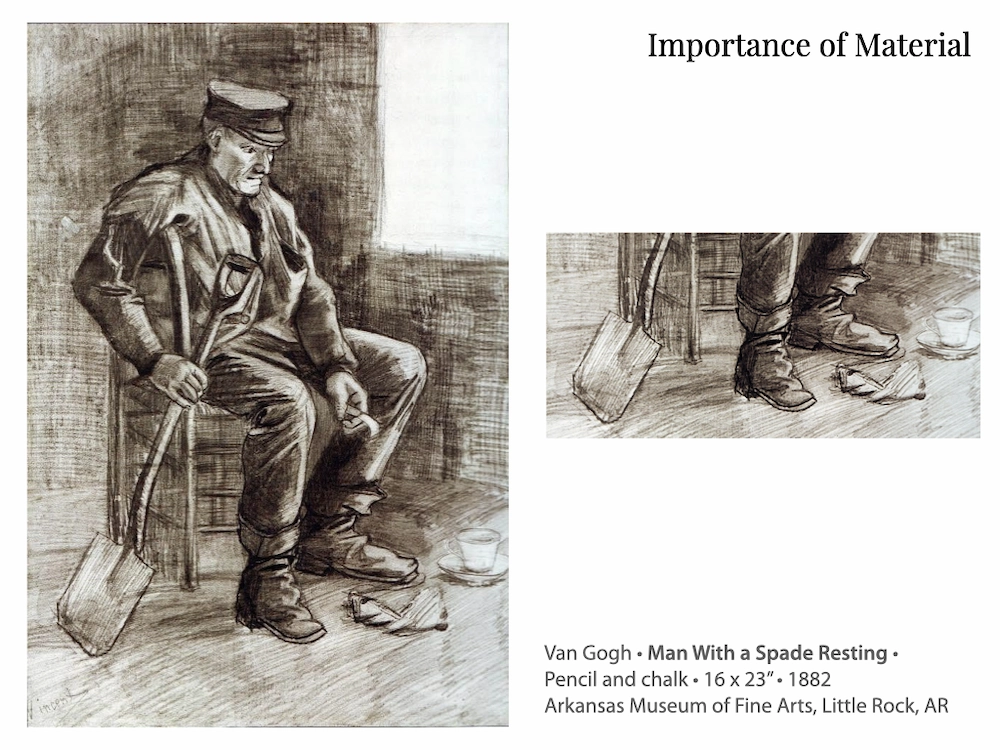
In 1880, Van Gogh was religious and politically engaged. Rather than resort to propaganda, Van Gogh, in Man with a spade resting, uses two types of line to subtly make his feelings known about the injustice disparity between two classes.
The blunt, thickly drawn B pencil that chisels out the Man, spade and tool and tears the paper is contrasted with a sharpened, delicately drawn contour line in an H pencil that draws a cup and saucer set on the floor to the man's right. One can't help wondering why Van Gogh put the
porcelain cup in this scene since the handle is too small to fit his finger and would break if kept in this environment. And that is the point. By simply changing to a different pencil Van Gogh has created a political and social statement.
The artist must consider both the use of the materials and the approach to depicting the objects the artist has chosen.
In 1880, Van Gogh was religious and politically engaged. Rather than resort to propaganda, Van Gogh, in Man with a spade resting, uses two types of line to subtly make his feelings known about the injustice disparity between two classes.
The blunt, thickly drawn B pencil that chisels out the Man, spade and tool and tears the paper is contrasted with a sharpened, delicately drawn contour line in an H pencil that draws a cup and saucer set on the floor to the man's right. One can't help wondering why Van Gogh put the
porcelain cup in this scene since the handle is too small to fit his finger and would break if kept in this environment. And that is the point. By simply changing to a different pencil Van Gogh has created a political and social statement.
The artist must consider both the use of the materials and the approach to depicting the objects the artist has chosen.